
Why you should know this
If crypto and equities fall together during a global shock, a portfolio that looked diversified may not behave that way when protection is needed. If the US dollar strengthens or interest-rate expectations change, funding conditions can influence many risk assets at once.
These relationships matter from basic market reading to advanced regime analysis. But the word “correlation” is often used too casually. We need returns, a window, a frequency and a method.
Correlation in plain language
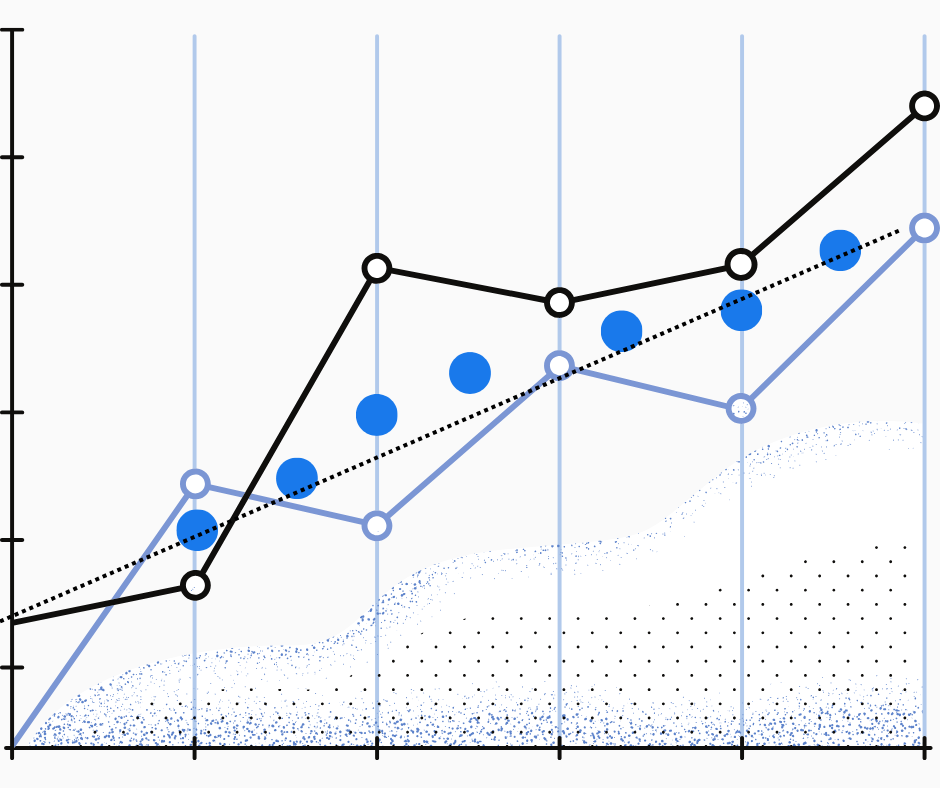
Correlation describes whether two series tended to move together over a selected sample:
- near +1: returns tended to move in the same direction;
- near 0: no stable linear co-movement was observed;
- near −1: returns tended to move in opposite directions.
Use percentage or log returns, not raw price levels. Two assets that both trend upward over years can show a misleading price-level relationship even when daily moves are unrelated.
Correlation is not causation, and it does not say the movements were the same size.
Crypto and stocks

IMF research has documented periods of increased co-movement and spillovers between crypto and equity markets, including in Asia. Possible channels include common investors, shared risk appetite, leverage and global liquidity.
The relationship is not fixed. A crypto-specific failure can break it. A stock-market event unrelated to crypto may produce little response. Always state the sample rather than saying “Bitcoin is a tech stock.”
Crypto and gold

Gold is often used as a store-of-value or defensive reference. Bitcoin is sometimes compared with it because both have scarcity narratives. Similar narratives do not guarantee similar market behavior.
Differences include market history, volatility, custody, regulation, industrial demand and participant base. Correlation may be positive, negative or weak depending on the period. The phrase “digital gold” is a thesis to test, not a measurement.
Crypto and the US dollar
Many crypto prices are quoted in USD or dollar-linked stablecoins. A broad strengthening dollar can coincide with tighter global financial conditions and weaker risk appetite, but the relationship is neither mechanical nor constant.
Separate three questions:
- Did the crypto asset change against USD?
- Did the local currency change against USD?
- Did the stablecoin or trading venue maintain the assumed conversion value?
For a Filipino reader, BTC/USD and USD/PHP can combine into a different BTC/PHP outcome.
Crypto and interest rates

Interest rates affect borrowing costs, discount rates, savings alternatives and liquidity conditions. A rise in expected rates can pressure long-duration and speculative assets, but crypto reactions depend on what was expected, the reason for the change and the current regime.
Distinguish:
- policy rate decisions;
- government-bond yields;
- real yields after inflation expectations;
- funding rates inside crypto derivatives.
They are related concepts, not interchangeable numbers.
Rolling correlation
A single full-history coefficient hides change. Rolling correlation recalculates the relationship over repeated windows—for example, the latest 30 daily returns.
Short windows adapt quickly but are noisy. Long windows are more stable but slow to show a new regime. Trying several windows after seeing the answer can become data-mining. Choose the decision horizon first.
Lead, lag and event timing

If US equities move during their session and crypto responds moments later, an analyst may test a lead–lag relationship. Clock alignment is critical because crypto is 24/7 while stock markets have sessions.
A lead–lag pattern can reflect shared news timing or data construction rather than a tradable advantage. Transaction cost, latency and out-of-sample testing matter.
A disciplined cross-asset worksheet
Record:
- assets and exact tickers;
- currency and data source;
- return interval;
- start and end date;
- missing-data treatment;
- correlation method;
- event or regime notes;
- limitations.
Then compare calm and stressed periods. If the result changes, that is not a failed analysis; it is evidence that the relationship is conditional.
Philippine and Asian context

Asian equities, JPY, CNY-related risk, regional regulation and local central-bank decisions can influence sentiment during Asian hours. IMF work has specifically examined stronger interconnections between Asian equity and crypto markets.
Do not translate a regional average into a claim about every Filipino investor or every token. Local access, currency exposure and product choice matter.
Common mistakes
- Correlating raw price levels instead of returns.
- Omitting the period, frequency and currency.
- Treating correlation as causation.
- Assuming a relationship survives market stress.
- Comparing 24/7 crypto data with unaligned stock sessions.
- Calling gold or equities a permanent crypto hedge.
- Using an in-sample relationship as a guaranteed trading edge.
A no-money correlation lab
Using a spreadsheet and historical data, calculate daily returns for a crypto asset and a stock index over two non-overlapping periods. Compute each correlation. Then write:
- what was observed;
- one possible shared driver;
- one data limitation;
- why the relationship may fail next time.
Do not optimize the dates to make the story prettier.
How this connects to market mastery
Correlation brings macroeconomics, currency, liquidity and portfolio risk into the crypto chart. Market mastery means knowing that relationships can strengthen, weaken or reverse—and building plans that do not require a fragile correlation to remain permanent.
Key takeaways
- Correlation needs returns, a window, frequency, currency and method.
- Crypto/equity spillovers have been observed, including in Asia, but are not constant.
- Gold, USD and rates each involve different mechanisms.
- Rolling analysis can reveal regime change but introduces window choices.
- Diversification should be stress-tested, not assumed.
Completion check: Compare the same two assets over two fixed windows and explain the difference without claiming causation.


