Why you should know this
Strategy and risk assumptions change when a market trends, ranges or transitions; mislabeling the state creates avoidable errors.
This is not about guessing the next candle. We are learning to organize evidence together, leave room for uncertainty and make the later decision reviewable.
The short answer
This lesson shows the four common market conditions and how not to confuse them.
Trend: movement with directional structure
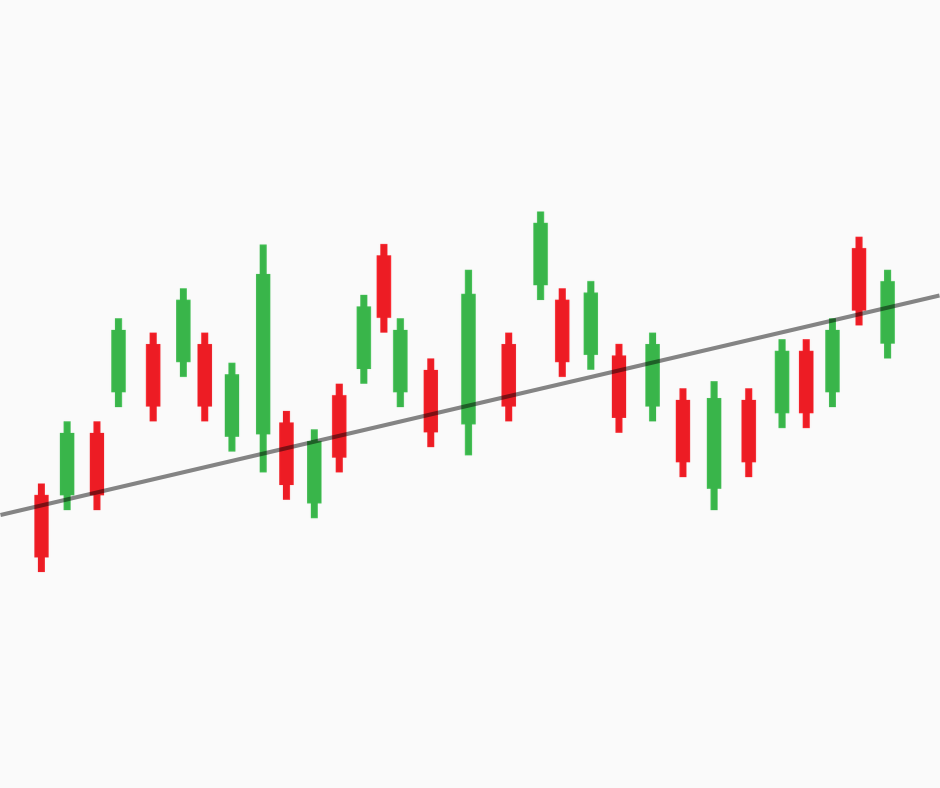
An uptrend is commonly described by rising swing highs and rising swing lows. A downtrend shows falling swing highs and falling swing lows. The exact swings depend on timeframe and method.
Trend does not mean price moves in a straight line. An uptrend contains declines; a downtrend contains rallies. The question is whether those moves preserve or damage the observed structure.
Good description: “On the daily chart, three meaningful swing lows have risen and price remains above the prior breakout area.”
Weak description: “It always goes up.”
Range: repeated trade between boundaries

A range develops when price rotates between an upper area and lower area without sustained progress. Boundaries are usually zones, not perfect lines.
Inside a range:
- price may reject near the edges;
- activity may concentrate around a central value area;
- false moves outside the boundary can occur;
- volatility can contract before expansion, but does not have to.
Calling a market “sideways” does not make it safe. Thin liquidity or sudden news can produce violent movement even after a quiet period.
Failed breakout: the market says “not yet”

A failed breakout moves beyond a boundary and then returns inside. Failure can trap traders who chased the first move, but we cannot know every participant’s position from the chart.
Define failure carefully. Is it a close back inside the range? A move through the opposite edge? A time limit with no follow-through? Different definitions produce different results.
Sometimes the best lesson is not “the breakout was fake.” It is “my rule accepted too little evidence for the risk I was taking.”
Reversal versus pullback

A pullback temporarily moves against an existing trend while its defining structure remains intact. A reversal changes that structure and begins to establish movement in the opposite direction.
Imagine a daily uptrend. One red candle is not automatically a reversal. Analysts may watch for:
- loss of a meaningful higher low;
- failure to recover;
- formation of a lower high;
- broader confirmation from volume, liquidity or context.
By the time a reversal is clear, the exact top or bottom may be gone. That is normal. Confirmation trades early certainty for better evidence.
A familiar Philippine or Asian example

At 8:00 a.m. in Manila, a learner records the venue, pair, timeframe, recent price behavior, activity, liquidity, local-currency context and scheduled events. They write two possible explanations and one condition that would change the view. No position is opened.
One risk or limitation
A market reading describes selected evidence; it does not reveal the future. Results can change with the venue, data method, window, currency, liquidity and event timing. One observation should never be presented as a certain prediction.
How this connects to market mastery
Market mastery begins with separating observation, interpretation and decision. A repeatable market read helps us compare scenarios, notice changing conditions and review why an earlier view did or did not hold.
Quick check — no money needed

Choose a historical market snapshot. Write three facts, two possible interpretations, one alternative scenario and one condition that would invalidate the first interpretation. Keep the observation separate from any decision.
If you can explain your answer and name the main uncertainty, this lesson is complete.