The Philippine peso has crossed a historic line, but the Bangko Sentral ng Pilipinas (BSP) says it will not spend the country’s dollar reserves to force it back.
The Philippine peso fell to a record low of ₱62.265 against the U.S. dollar in late August 2026, extending its decline from the previous record of ₱61.888 recorded just a day earlier.
The sharp movement reflects growing demand for the US dollar as global investors respond to geopolitical uncertainty, elevated oil prices, and continued dollar strength.
The development has raised concerns among Filipinos because a weaker peso can make imported goods more expensive. Fuel, food, fertilizers, machinery, and other products priced in dollars can all become costlier when the local currency loses value.
Despite the peso’s historic decline, BSP Governor Eli Remolona Jr. said the central bank cannot simply push the currency back below ₱60.
During a Senate finance committee briefing, Sen. Erwin Tulfo asked whether the peso could fall below ₱60 or continue to weaken.
Remolona responded: “We can try to slow it down, but we cannot fix it at P60. We can’t do that. We would run out of reserves. We would run out of dollars.”
There is therefore no bill or government measure that simply fixes the peso at ₱60 to the dollar. The BSP’s position is that maintaining a specific exchange-rate level would be costly and unsustainable.
BSP Focuses on Stability, Not a Fixed Exchange Rate
The BSP’s approach is to manage excessive movements rather than guarantee a particular peso-dollar rate.
According to Remolona, the central bank can intervene when the currency experiences unusually sharp movements, but it cannot continuously use foreign exchange reserves to defend a specific level. Doing so could quickly reduce the country’s supply of dollars and leave the economy more vulnerable to future external shocks.
The governor explained the importance of controlling volatility because the speed of the peso’s decline can affect inflation.
“If the peso weakens very sharply, the impact of the exchange rate on inflation is greater. But if the movement is gradual, inflation is not affected as much,” Remolona said.
This distinction is important for consumers. A sudden drop in the peso can immediately increase the local cost of imported products, particularly fuel. Since transportation and production costs are connected to fuel prices, higher import costs can eventually spread throughout the economy.
The latest decline came even after the BSP raised its benchmark interest rate by 25 basis points to 5%. The increase marked the third consecutive rate hike and brought cumulative tightening from April to 75 basis points.
Normally, higher interest rates can support a currency by making local assets more attractive. However, the peso continued to weaken as global factors remained dominant.
Trade Deficit and Savings Gap Put Long-Term Pressure on the Peso
Beyond short-term market movements, the peso’s weakness reflects deeper challenges in the Philippine economy.
The country has maintained a negative current account for an extended period, meaning foreign currency outflows have remained greater than inflows.
The Philippines receives large amounts of dollars through Overseas Filipino worker (OFW) remittances and the business process outsourcing (BPO) industry, but these inflows do not completely offset the country’s import requirements.
Remolona also pointed to the relationship between national savings and investment. When investment and consumption exceed domestic savings, the country must rely on financing from abroad to cover the gap.
This explanation, however, has drawn criticism from some lawmakers. Representative Sarah Elago argued that low household savings should not simply be viewed as a result of excessive consumption.
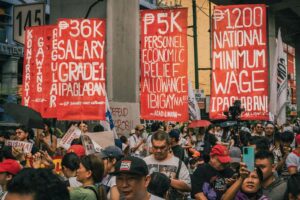
She pointed to low wages, regressive tax structures, and high living costs as factors that limit the ability of Filipino families to save.
The debate highlights that the peso problem cannot be solved by monetary policy alone. Interest rates may help manage inflation and market volatility, but long-term currency strength also depends on the country’s ability to produce more goods and services for export while building stronger domestic savings.
Exports and Savings Seen as the Long-Term Answer
For the BSP, stronger exports are among the most important long-term solutions to the country’s exchange-rate challenge.
Remolona cited initiatives such as Pax Silica and the Luzon Economic Corridor, which are intended to support investment, production, and export capacity.
Expanding the country’s ability to sell goods and services abroad could generate additional dollar inflows and reduce dependence on imported products and foreign financing.
However, these measures cannot strengthen the peso overnight. Large infrastructure, investment, and industrial projects require time before they can significantly change the country’s export capacity.
In the meantime, the peso remains exposed to developments outside the Philippines. Analysts have pointed to broad US dollar strength, elevated oil prices, importer demand, and uncertainty in global financial markets as major factors behind the recent decline.
DBS Bank noted that the Philippine peso was the only ASEAN-6 currency to weaken against the dollar during the third quarter of 2026, declining by 0.8%, while other regional currencies gained between 0.9% and 1.7%.
With these pressures continuing, the BSP’s goal remains focused on preventing disorderly movements rather than defending ₱60 at all costs.
DOPAY: Turning Remittances Into Greater Financial Resilience
As the peso faces continued volatility, remittances remain one of the Philippines’ most stable sources of dollar inflows. This makes the way Filipinos send and receive money across borders increasingly important.
As the BSP makes clear, the government cannot simply pass a bill or use reserves indefinitely to hold the peso at ₱60. Long-term stability requires stronger exports, higher domestic savings, sustainable investment, and reliable sources of foreign currency.
DOPAY can form part of this wider financial picture by making cross-border transfers more efficient and affordable.
By helping Filipinos move their earnings securely while reducing unnecessary transfer costs, the platform offers a practical way for individuals to participate in a stronger flow of remittances.
With DOPAY, OFWs can send money from anywhere, including Japan, Hong Kong, Dubai, and beyond, to the Philippines quickly and affordably while enjoying secure and transparent transactions.
For our beloved OFWs, DOPAY guarantees peace of mind. Simply top up your DOPAY wallet and send funds directly to your family’s DOPAY wallet in pesos, all within the app.
And with DOPAY’s Crypto Wallet, users can earn crypto rewards through the Trade & Earn program. Plus, the Refer & Earn program opens new opportunities for Filipinos to boost their income with every successful referral.
Download the DOPAY app today!