Why you should know this
A strategy can look broken when the environment has changed, and a profitable result can look skilled when the regime simply favored the strategy. Regime classification gives context to every later decision.
Academy 16 is where earlier lessons stop being separate subjects. Technical analysis, fundamentals, sentiment, on-chain evidence, risk, execution, psychology, technology, regulation and local market structure now have to coexist in one decision. The goal is not to sound certain. The goal is to make the reasoning strong enough that another careful reader can inspect it and that your future self can learn from it.
The exercise starts before you know the ending

Use a historical, fictional or frozen-data case. Write the as-of time, available evidence, assumptions and decision rules before revealing later information. The exercise is not a quiz with one hidden correct answer. It is a test of whether your reasoning can be reconstructed and challenged.
Choose three historical dates from different market conditions. Freeze the data available on each date and classify trend, volatility, liquidity, breadth and leverage/positioning separately. Write the strategy types that fit poorly and the evidence that would move the regime to a different state.
Build the decision record
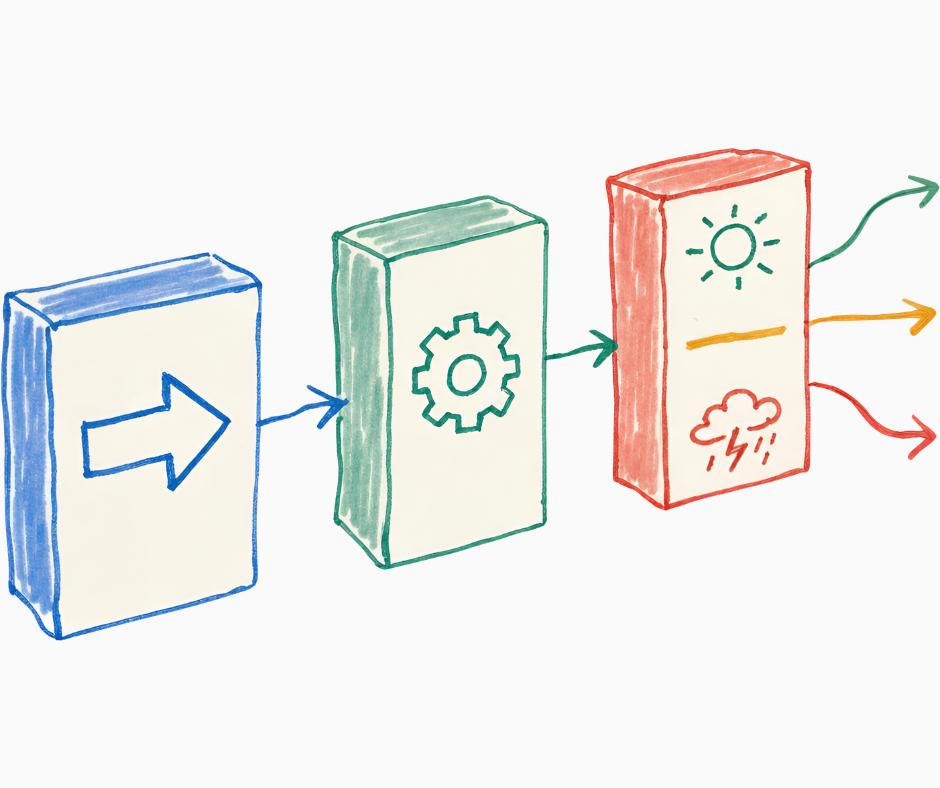
Your record should contain five layers:
- Facts and evidence. What is directly observed, with source, date, unit and method where relevant.
- Interpretation. What you think the evidence means, clearly separated from the facts.
- Competing interpretation. The strongest reasonable alternative explanation.
- Decision and boundary. What you would do—or deliberately not do—and what evidence would change that decision.
- Risk and implementation. What can fail even if the interpretation is directionally correct.
Do not award yourself extra points for a profitable or directionally correct outcome. The purpose is to make the process defensible before hindsight arrives.
Reveal the outcome and perform the post-analysis
After the original record is frozen, reveal the later historical outcome or the second half of the fictional case. Compare what actually happened with what the original process expected. Classify each important difference as bad evidence, bad interpretation, missing scenario, execution/operational failure, regime change, or ordinary uncertainty.
Do not move the original invalidation, benchmark, threshold or decision rule to make the record look better. If a rule should change, record the proposed new version separately.
A mastery scorecard
Score the exercise from 0–2 on each dimension: evidence quality, assumption clarity, competing explanations, risk control, decision consistency and post-analysis honesty. A total score is less important than the weakest dimension. Write one concrete improvement for that weakness before starting the next family.
Review questions
- Was each regime label tied to observable criteria?
- Did you allow an uncertain or transitional state?
- Which variable changed the decision most?
- Did hindsight tempt you to relabel the earlier environment?
- What is the earliest evidence that the regime may have shifted?
Finish with a short paragraph answering: What will I keep, what will I change, and what evidence justifies the change? This closes the loop from analysis to improvement.
Philippine and Asian application

When the case involves a Philippine or Asian user, add the local layer instead of assuming a global USD market is the whole decision. Record the relevant currency, venue or provider, trading hours where material, liquidity/FX effects, jurisdiction and any operational route needed to turn the market decision into a usable outcome. Do not infer that a globally available protocol, asset or product is supported for every user or jurisdiction.
What mastery does not mean
Mastery does not mean perfect prediction, constant profit, immunity from loss, or the ability to eliminate uncertainty. It means that uncertainty is handled deliberately: sources are traceable, assumptions are visible, risk is bounded, alternatives are considered, operational constraints are respected, and the post-analysis is honest enough to improve the next decision.
Completion check
You are not finished because you can repeat the terminology. You are finished when another careful reader can reconstruct the reasoning, identify the assumptions, challenge the competing explanation, see the decision boundary and understand what you learned after the outcome.