The Department of Agriculture (DA) is exploring ways to balance the current position of local farmers in the local rice industry.
One of the considerations that the DA is looking into is to impose a higher tariff by at least 13 percentage to rice imports from four of the country’s major suppliers, including Vietnam, Thailand, Myanmar, and Pakistan.
The idea is to “neutralize” the price disadvantage and protect local farmers as imported rice usually enters the market at 14-35% lower than locally produced rice.
The DA’s Policy Research Service-Trade Remedies Office (PRS-TRO) concluded that the increase in number of rice imports has seriously injured the local rice sector and has recommended to implement increase in tariffs as a safeguard of measurement.
The proposed tariffs increase would take the form of cash bonds. Importers would pay this bond when bringing rice shipments to the country, which acts as a financial deterrent and provides immediate relief to local farmers.
However, this applies only to rice that is classified under HS Code 1006.30, which covers semi-milled and wholly milled rice, whether polished or glazed, such as: Parboiled Rice, Jasmine Rice, Basmati Rice, Organic Rice, and Short/Medium Grain.
During the start of January 2020 up until August 2025, it was found that around 82 percent of the total import volume of 20.54 million metric tons (MT) was dominated by HS 1006.30-classified rice.
This just shows why the proposed safeguard measures need to be implemented to aid local farmers.
The intent is to curb the overwhelming inflow of semi-milled and wholly milled rice, which has been undercutting local farmers’ prices. Other categories have a small impact on the prices in comparison to the HS 1006.30 rice classifications.
As a result, the PRS-TRO specified that the tariff increase would only apply to those who are principal suppliers of HS 1006.30 which are: Vietnam (82% of total imports), Thailand (8%), Myanmar (5%), and Pakistan (4%). These four countries are dominating the local rice import market.
Raising tariffs directly to these suppliers not only addresses the source of injury which would be defensible under the trade rules; it will also reduce the competitive pressure from cheaper imports and help stabilize farmgate prices.
Historical Consumption Data and How They Relate to Today’s Safeguards
From 2020 to 2024, the Philippines recorded rice consumption hike from 9.61 million MT to 11.87 million MT.
Throughout this period, reports show that imports remarkably expanded from 22% to 37%. On the other hand, the domestic industry’s share fell from 78% to 63%, even though the domestic market regained recovery signs at 69% during the first eight months of 2025.
With these, farmers noted that the temporary restrictions during the first half of 2025 did not dramatically improve rice prices. Even without the imports, domestic prices stayed weak; local farmers had feared that once the import continues, another round of losses will hit.
For this reason, the PRS-TRO emphasized how the rise of imports is the direct reason for the continuous decline of domestic market share, showing that imported rice was capturing the masses’ demand at the expense of locally produced rice.
Imported rice has consistently been 14-35% cheaper in the market than locally produced rice. The uncontrolled market competition forced local farmers to hold back on price increases despite the rising production cost.
Moreover, this does not only affect the farmers but also the millers and traders included in the rice value chain.
To counter this, the PRS-TRO suggests that the safeguard tariff be based on the average injury margin of 13% (the price gap between imported goods vs. locally produced goods). If approved, the tariff level would be higher than the original 35%.
Hindrances and Struggles Faced by Filipino Farmers
South Asian neighboring country Pakistan questioned the planned tariff hike through the World Trade Organization (WTO), arguing that the Philippines has failed to comply to the WTO rules needed to implement it.
Pakistan Trade and Investment Officer Fareeha Khan argued that the surge in rice imports was not due to “unforeseen developments” but because of the local government’s own decision to lower tariffs from 35% to 15% under the decision of Philippines President Marcos Jr. laid out by Executive Order No. 62 last June 2024, reducing the tariffs rates on imported rice and other agricultural commodities to stabilize the domestic food supply.
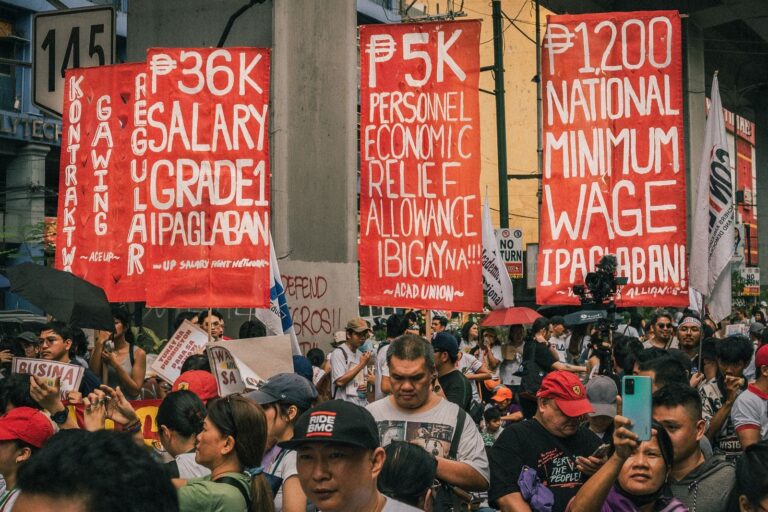
However, local farmer groups contend that the tariff cuts just only triggered an influx of cheap foreign rice, forcing farmers to sell unmilled rice at a lower cost, leaving another disadvantage for the local farmers.
At the same time, Vietnam stays as the top supplier through imports totaling to 2.11 million MT. The Vietnam’s Trade Remedies Authority (TRAV) stressed that any safeguard measure must meet WTO requirements under the General Agreements on Tariffs and Trade (GATT) 1994.
The country urged the Philippines to point out the injury caused by imports from other factors such as weather, rising cost, or domestic policies and weigh its broader impact on food security, inflation, and market stability.
According to Article 19 of the GATT 1994, WTO members may apply safeguard measures when imported products in increased quantities threaten or cause serious injury to the domestic industry. The safeguard is meant to be temporary protection while the industry adjusts.
The Philippines should demonstrate that the import surge was due to unforeseen developments, and not just policy to choices, to legally justify the safeguard measure. Otherwise affected countered could contest the measure at the WTO.
DOPAY Offers Lower Fees Amid Price Hikes
DOPAY is a digital wallet licensed as both an Electronic Money Issuer (EMI) and a Virtual Asset Service Provider (VASP) by the BSP, offering secure and regulated digital financial services.
Rising rice prices due to tariffs continue to put pressure on everyday expenses, making life more challenging for many Filipino families.
With DOPAY, Filipinos can be confident to send money and trade crypto thanks to its low-cost e-wallet and crypto wallet services that empower Filipinos with affordable financial tools.
Unlock more opportunities through our Refer & Earn program and earn rewards equivalent to a cryptocurrency of your choice.
Download the DOPAY app today!